History - Tigers
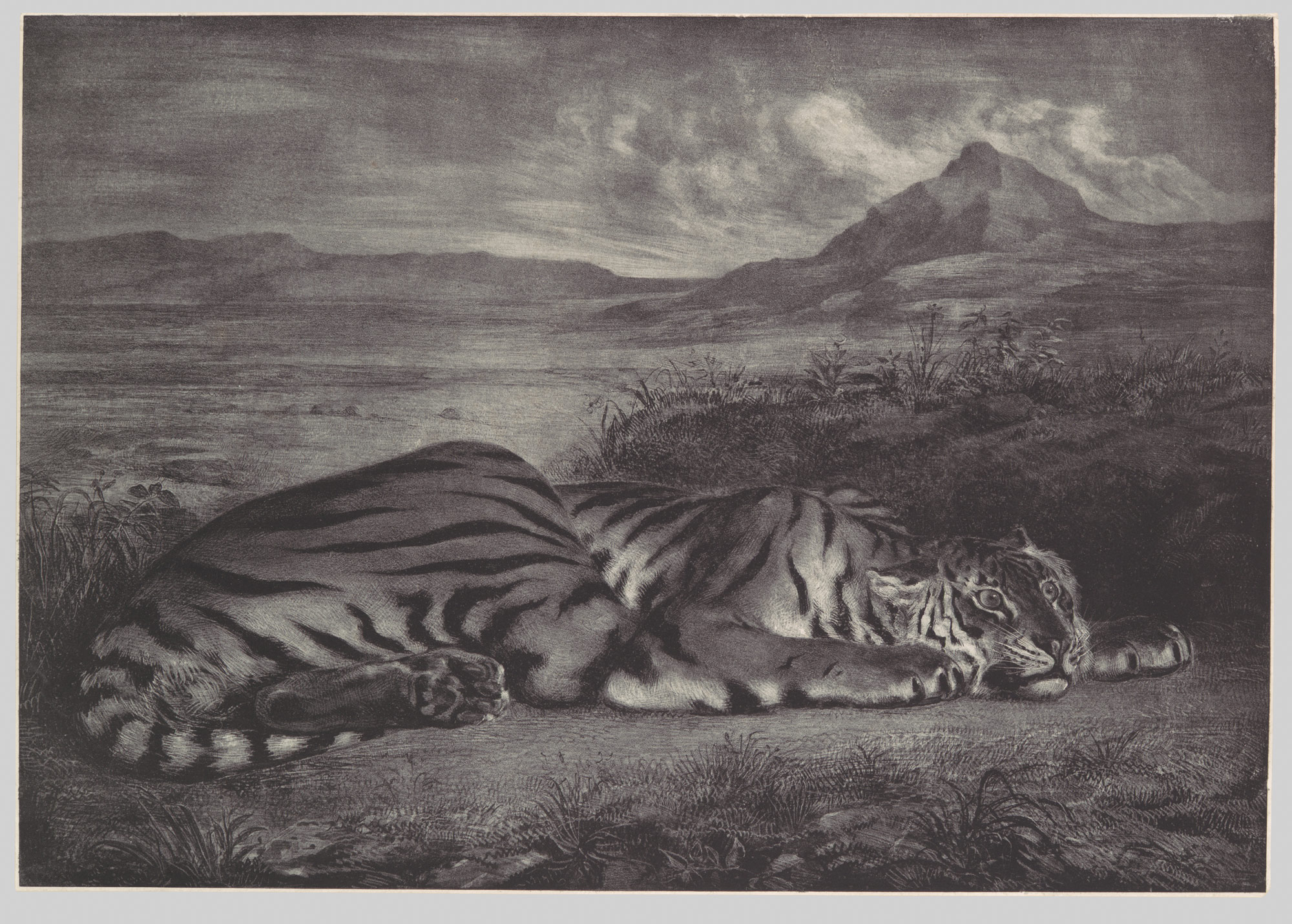
In 1758, Linnaeus described the tiger in his work Systema Naturae and gave it the scientific name Felis tigris. In 1929, the British taxonomist Reginald Innes Pocock subordinated the species under the genus Panthera using the scientific name Panthera tigris.
The word Panthera is probably of Oriental origin and retraceable to the Ancient Greek word panther, the Latin word panthera, the Old French word pantere, most likely meaning "the yellowish animal", or from pandarah meaning whitish-yellow. The derivation from Greek pan- ("all") and ther ("beast") may be folk etymology.
The specific epithet, tigris, as well as the common name, tiger, come from the Middle English tigre and the Old English tigras (a plural word), both used for the animal. These derive from the Old French tigre, itself a derivative of the Latin word tigris and the Greek word tigris. The original source may have been the Persian tigra meaning pointed or sharp and the Avestan tigrhi meaning an arrow, perhaps referring to the speed with which a tiger launches itself at its prey.
Evolution
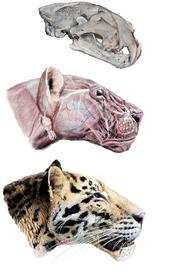
The tiger's closest living relatives were previously thought to be the lion, leopard and jaguar, all of which are classified under the genus Panthera. Genetic analysis indicates that the tiger and the snow leopard diverged from the other Panthera species about 2.88 million years ago, and that both species may be more closely related to each other than to the lion, leopard and jaguar.
The oldest remains of an extinct tiger relative, called Panthera zdanskyi or the Longdan tiger, have been found in the Gansu province of northwestern China. This species is considered to be a sister taxon to the extant tiger and lived about 2 million years ago, at the beginning of the Pleistocene. It was smaller than the modern tiger, being the size of a jaguar, and probably did not have the same coat pattern. Despite being considered more "primitive", the Longdan tiger was functionally and possibly ecologically similar to its modern cousin. As Panthera zdanskyi lived in northwestern China, that may have been where the tiger lineage originated. Tigers grew in size, possibly in response to adaptive radiations of prey species like deer and bovids which may have occurred in Southeast Asia during the early Pleistocene.
The earliest fossils of true tigers are from Java, and are between 1.6 and 1.8 million years old. Distinct fossils are known from the early and middle Pleistocene deposits in China and Sumatra. A subspecies called the Trinil tiger (Panthera tigris trinilensis) lived about 1.2 million years ago and is known from fossils found at Trinil in Java.
Tigers first reached India and northern Asia in the late Pleistocene, reaching eastern Beringia (but not the American Continent), Japan, and Sakhalin. Fossils found in Japan indicate the local tigers were, like the surviving island subspecies, smaller than the mainland forms, an example of insular dwarfism. Until the Holocene, tigers also lived in Borneo, as well as on the island of Palawan in the Philippines.
The tiger's full genome sequence was published in 2013. It and other cat genomes were found to have similar repeat composition and an appreciably conserved synteny.
Description
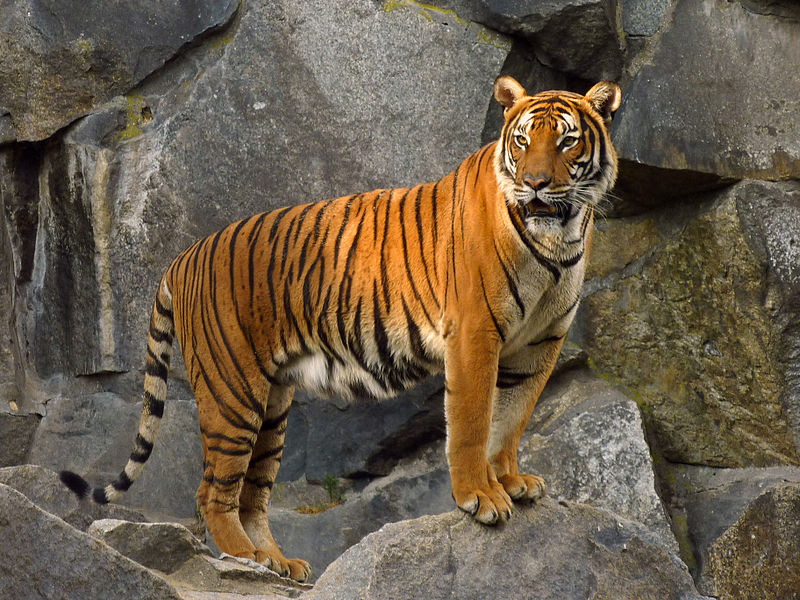
Tigers have muscular bodies with powerful forelimbs, large heads and long tails. The pelage is dense and heavy; colouration varies between shades of orange and brown with white ventral areas and distinctive vertical black stripes, whose patterns are unique to each individual. Their function is likely for camouflage in vegetation such as long grass with strong vertical patterns of light and shade. The tiger is one of only a few striped cat species; it is not known why spotted patterns and rosettes are the more common camouflage pattern among felids. The tiger's stripes are also found on the skin, so that if it were to be shaved, its distinctive coat pattern would still be visible. They have a mane-like heavy growth of fur around the neck and jaws and long whiskers, especially in males. The pupils are circular with yellow irises. The small, rounded ears have a prominent white spot on the back, surrounded by black. These false "eyespots", called ocelli, apparently play an important role in intraspecies communication.
The skull is similar to that of the lion, though the frontal region is usually not as depressed or flattened, with a slightly longer postorbital region. The skull of a lion has broader nasal openings. However, due to variation in skulls of the two species, the structure of the lower jaw is a more reliable indicator of species. The tiger also has fairly stout teeth; the somewhat curved canines are the longest among living felids with a crown height of up to 90 mm (3.5 in).
The oldest recorded captive tiger lived for 26 years. A wild specimen, having no natural predators, could in theory live to a comparable age.